Mirror and shoulder checks
Mirror and shoulder checks are two of the most important habits in safe driving. Mirror checks keep you aware of what’s happening around your car, while shoulder checks catch the vehicles hiding in your blind spots — the areas your mirrors can’t reach.
In this guide:
- The three types of mirror checks and when each one applies
- How the MSM routine works, and why the order matters more than most drivers realise
- When a shoulder check is non-negotiable, and how to make every observation count
Why These Checks Matter More Than You Think
At 70 mph, you cover roughly 315 metres in just 10 seconds — about the longest you’d want to go between routine mirror checks. Put in those terms, mirror discipline stops looking like something the examiner wants to see and starts looking like a habit worth keeping for life.
Most collisions happen because a driver simply didn’t know what was around their car. Mirrors show you a great deal, but they leave gaps, and those gaps are exactly where danger tends to sit. It’s no coincidence that poor observation is one of the most common reasons learners fail the practical test.
The Three Types Of Mirror Checks You Need To Know
Not every mirror check does the same job. Knowing which one to use and when turns a quick glance into genuinely useful information and keeps your picture of the road accurate rather than guessed at.
Routine Mirror Checks
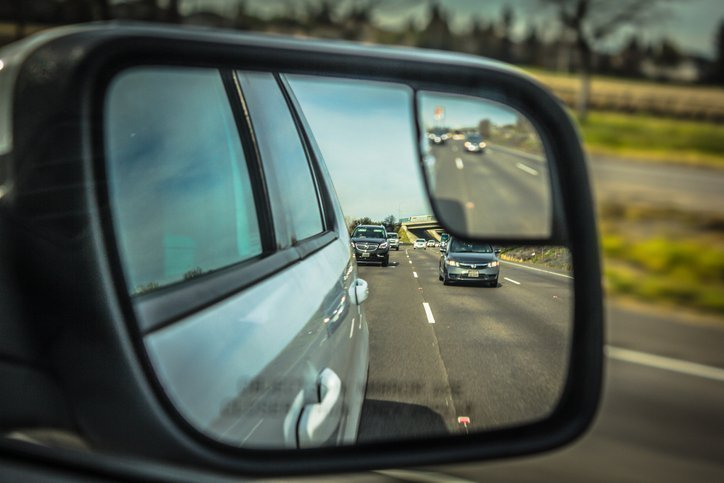
Think of these like refreshing a browser tab. Every 8–10 seconds during normal driving, rotate through the rear-view and both door mirrors to build a continuously updated mental map of the traffic around you. The aim is for this to run in the background — a steady process alongside everything else you’re doing behind the wheel, rather than something you have to consciously trigger.
Rear-View Mirror Checks
The rear-view is the first thing to reach for before slowing down. If the car behind is sitting close, a sharp stop can turn a routine deceleration into a rear-end collision that nobody planned for.
- Check before braking or decelerating to gauge the following distance behind you
- If someone is sitting too close, brake earlier and more gradually to give them time to react
- It’s also useful for judging the gap when you’re being overtaken on a faster road
Door Mirror Checks
The door mirrors cover what the rear-view misses — the space to either side of the car. They matter most before any sideways movement, especially at junctions where cyclists have a habit of appearing at exactly the wrong moment.
- Left door mirror: check before moving or turning left, and for cyclists approaching at junctions
- Right door mirror: check before overtaking, turning right, or changing lanes on a dual carriageway
- Always check the relevant door mirror before signalling, not after
The MSM Routine — Mirror, Signal, Manoeuvre
MSM applies to every change in speed or direction, not just junctions. The Highway Code is explicit that you should use your mirrors in good time before you signal or change direction or speed. What makes the routine work isn’t simply running through the steps — it’s understanding why they sit in that specific order.
| Step | What It Means | Why It Comes First |
| Mirror | Check what’s around you before committing | You need to know it’s safe before you tell anyone what you’re doing |
| Signal | Tell other road users your intention | Gives them time to react before you move |
| Manoeuvre | Carry out the action smoothly | The move only happens once you know it’s clear |
Signalling first and checking afterwards reverses that logic, and it’s one of the most common mistakes on and off the test. A second mirror check after signalling is worth building in too, because the situation can change in the few seconds between the signal going on and the move happening.
What Is a Shoulder Check, and When Do I Use It?
Your mirrors are good, but they leave a blind spot roughly between the rear of your car and the outer edge of the door mirror’s field of view. It’s a real gap, and it’s exactly where cyclists and motorbikes tend to sit at the least convenient moment.
A shoulder check is a brief, decisive glance over your shoulder into that space — a quick look to confirm whether something’s there before you commit, not a slow five-second neck rotation.
Situations That Always Need A Shoulder Check
These are the moments where mirrors alone aren’t enough, and skipping the check is a genuine safety risk rather than just a sloppy habit.
- Moving off from a stationary position — before pulling away from a parked spot or kerb
- Turning at junctions — cyclists or pedestrians may be approaching from the near side
- Exiting a roundabout — especially on multi-lane roundabouts where vehicles emerge from unexpected angles
- Changing lanes on motorways or dual carriageways — where the blind spot risk runs highest
- Merging onto a carriageway from a slip road — traffic may already occupy the lane you’re joining
Turning A Mirror Glance Into A Decision: Take, Use, Give
MSM tells you what to do and in what order. The part it doesn’t spell out is how to think while you’re doing it — and that’s where the Roadcraft approach to information helps. Advanced driving frames every observation around three things you do with what you see: take it in, use it, and give information back to other road users. It’s what turns a tick-box glance into an actual decision.
- Take: What are you actually seeing? How close is the car behind? Is it closing fast? Is there a cyclist to your left?
- Use: Does that information change what you’re about to do — brake more gently, hold off the lane change?
- Give: Communicate your intent clearly, through your signal, your road position, and eye contact where possible
In practice it takes under two seconds. Say you check your rear-view before braking and notice a van sitting about a car’s length back. Rather than braking sharply, you ease off earlier and decelerate more gradually, giving the van time to respond — you’ve taken the information, used it, and adjusted before it became a problem.
Common Mistakes And How To Fix Them
Most of these are habits that quietly collapse after the test, once nobody’s watching. They’re worth naming plainly.
- Checking without processing — a glance means nothing if nothing registers, so give yourself the half-second to actually read what’s there
- Only using the rear-view and forgetting the door mirrors exist during normal driving
- Skipping the shoulder check on moves off or lane changes because it feels unnecessary in the moment
- Signalling before checking mirrors, which reverses MSM and undermines the whole point of it
- Mistiming the shoulder check — it should happen just before the manoeuvre, not ten seconds earlier when the picture will already have changed
Building The Habit So It Lasts
The gap between catching a problem and causing one often comes down to a single glance, taken at the right moment and acted on calmly.
- Rotate through all three mirrors every 8–10 seconds during normal driving to keep your picture of the road current
- Run MSM in the right order — mirror before signal, signal before manoeuvre, every time
- Add a shoulder check before any move off, lane change, or junction turn where a cyclist could be sitting in the gap
- Take, use, and give — treat each mirror glance as a decision rather than a reflex
None of the mechanics are complicated. The work is in making the checks consistent enough that they become second nature and keep running long after the test is a distant memory.